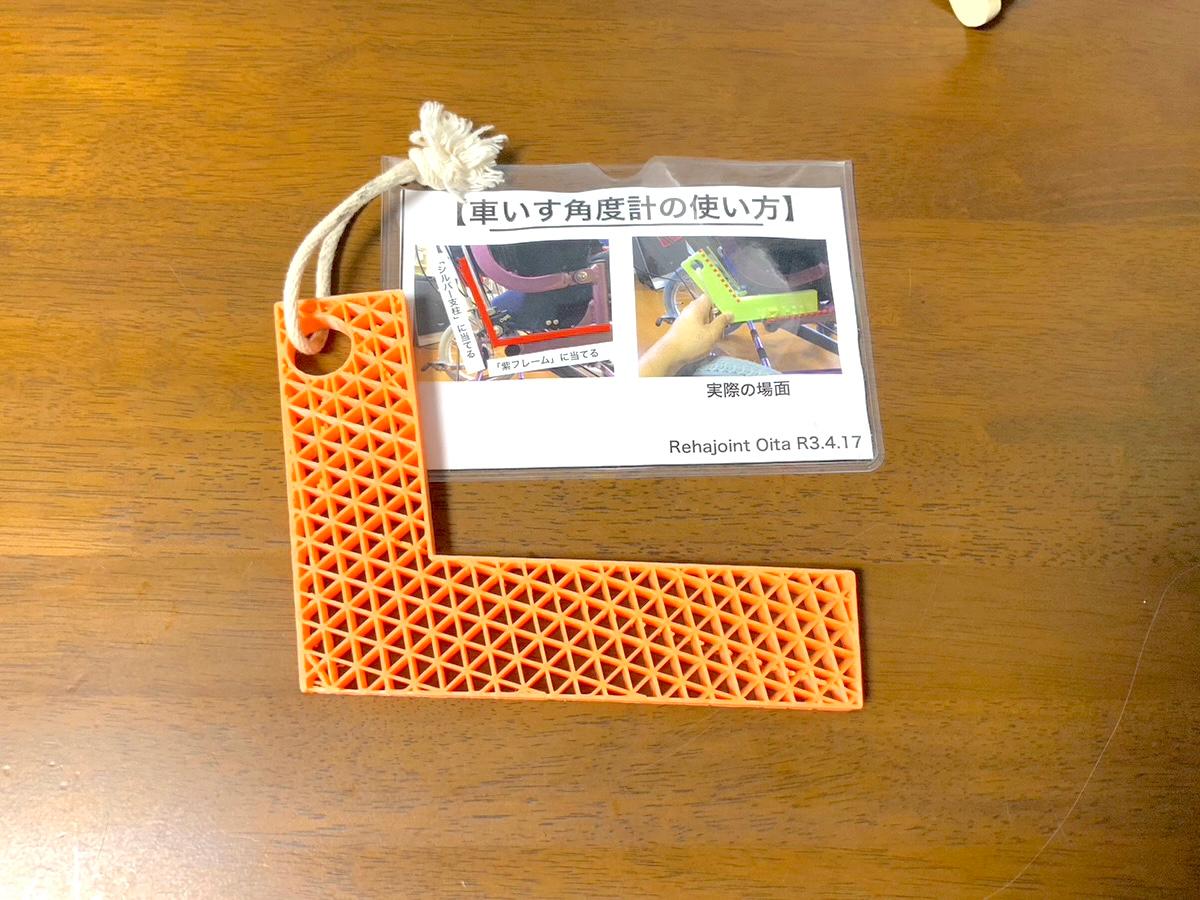
Angle OK (Gauge)—CS-03
角度 OK(計)—CS-03
- Category
- Mobility
- Designer
- Munehiko Matama
- Material
- PLA
- Downloads
- 9
About this item
For (With Whom)
People who need their back-to-seat angle adjusted in wheelchair seating.
Why
The user has quadriplegia and a prolonged disorder of consciousness after a traffic accident, and lives at home using a reclining wheelchair. Many professions are involved in home services, including home-visit physicians, visiting nurses, home helpers, and visiting rehabilitation. The user tends to slide forward in the wheelchair and aspirates saliva, so the seat angle and back-to-seat angle needed adjusting. The people involved requested a tool that anyone could use to adjust it quickly, as it would make seating easier, so we made it.
Printing tips
How
First, the user sat in the reclining wheelchair and seating was carried out. The back-to-seat angle was determined once the seat angle that prevents forward sliding and the adjustment that prevents saliva aspiration were achieved (the seat angle varies by situation and is set with a slope rather than flat, so it was not specifically defined). We made an angle gauge that can be read at a glance for that back-to-seat angle. In making it, so that it is readable at a glance (so that the frame of the reclining wheelchair can be seen), the top and bottom of the printed object were set to "0" in the slicer application.
Outcome
With Angle OK (Gauge), the back-to-seat angle can now be adjusted easily. As a result, the user can get out of bed into the wheelchair safely without aspirating saliva.
Materials Used
PLA
Approximate 3D Print Weight
21g
Print Settings Overview
Body, sides: Nozzle diameter = 0.8mm, Layer height = 0.4mm, Infill = 40%, Temp = 220°C (hot), Speed = 50mm/s, Supports = none
Accessory Information
None